
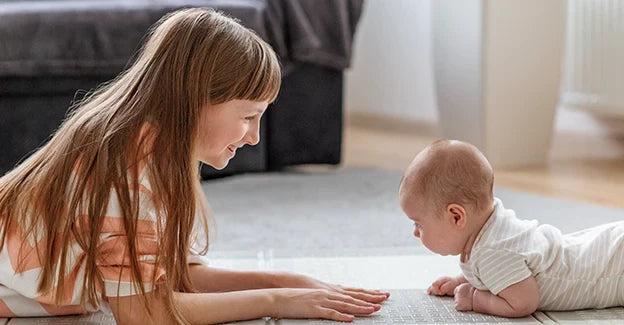
Floor time sounds very simple, doesn’t it? It is just your baby spending time on the floor, usually on a soft and safe surface, with space to move, stretch, wiggle, roll and explore. But this simple everyday activity plays a big role in how your baby’s body grows stronger.
In the early months, babies are learning what their little bodies can do. Every kick, reach, head turn and wriggle is part of their motor development. This means the way they learn to control their muscles, balance their body and move from one stage to the next. Floor time gives them the freedom to practise all of this naturally, without being held in one position for too long. Using a soft and comfortable baby mat during floor time also creates a safe, cushioned space where babies can move, stretch, and explore more freely. Let’s give you a refresher.
Why floor time matters so much
Babies are not born with perfect control over their movements. At first, many of their movements are tiny reflexes. Slowly, they begin to move with more purpose. They learn to turn towards your voice, look at a toy, reach for something colourful and push their body up during tummy time.
This is where floor time becomes so useful. When your baby lies on their tummy, they practise lifting their head. When they lie on their back, they kick their legs and move their arms freely. When they turn to the side, they begin to understand balance. Over time, these small actions help prepare them for bigger milestones like rolling, sitting, crawling and pulling up to stand.
Think of floor time as your baby’s little workout, but without any pressure. There is no need to make it complicated. A few short sessions through the day can make a lovely difference. Your baby gets to move, play and learn at their own pace.
It helps with rolling and crawling
Rolling is one of the first big signs that your baby is learning how to move independently. Before rolling fully, babies often practise by turning their head, twisting their hips, bringing their hands together or shifting to one side. These movements may look small, but they are important.
Floor time gives your baby enough room to practise these steps. Too much time in rockers, seats or carriers can limit movement because the body is supported in one fixed position. These products can be helpful for short periods, but babies also need open space to move freely.
Once your baby starts rolling, crawling is the next exciting stage. Crawling needs arm strength, leg strength, balance and coordination. Your baby has to learn how to use the right and left sides of the body together. Floor play helps them practise this slowly and naturally.

It supports balance and coordination
Motor development is not only about strong muscles. Your baby also needs to understand balance, body position and movement. During floor time, babies learn where their arms and legs are, how to shift weight and how to move without falling over.
This is also why the right surface matters. A baby mat should feel soft enough for comfort but firm enough to support movement. If the surface is too squishy, your baby may find it harder to push up or balance. A clean, open and safe floor space lets your baby move with confidence.
Good quality products for babies can support these everyday moments, especially when they are made with comfort and safety in mind. For example, Nintara Baby Sleeping Mats can help create a cosy resting space, while still keeping your baby’s comfort at the centre. For active play and movement, Nintara Baby Landing Mats can be a helpful choice for floor time, rolling practice and gentle play.

It encourages sensory learning too
Floor time is not only good for muscles. It also supports sensory development. Your baby sees different colours, hears sounds around the room, feels textures under their hands and feet, and notices how their body moves against the floor.
Place a toy slightly to the side and your baby may turn their head. Put a soft rattle nearby and they may try to reach for it. Lie down near them and talk gently, and they may try to look up or move towards your voice. These simple moments help your baby connect movement with curiosity.
Pro tip: There is no need to fill the area with too many toys. A few safe objects are enough or else the baby will feel overwhelmed.
What if your baby does not like floor time?
Some babies fuss during floor time, especially tummy time. That is very normal. Being on the tummy can feel strange at first because it takes effort. The trick is to start small.
Try one or two minutes at a time. Get down on the floor and talk to your baby face to face. Use a favourite toy, sing a little song or place them on your chest while leaning back slightly. As your baby gets stronger, they may begin to enjoy it more.
Avoid turning floor time into a task. It should feel like play, not training. If your baby is tired, hungry or upset, try again later. A few happy minutes are better than a long session full of tears.
Making floor time part of your routine
The easiest way to include floor time is to add it to moments that already happen during the day. Try it after a nappy change, after a nap or during playtime when your baby is alert. Keep the space clean, remove anything unsafe and always stay close.
You can also rotate positions. Give your baby time on their back, tummy and sides. Each position helps the body in a different way. Over the months, these little sessions build the foundation for sitting, crawling, standing and walking.
Choosing practical baby accessories can make floor time more comfortable for both you and your little one. When the space feels soft, safe and inviting, it becomes easier to make this a regular part of the day.
Floor time may look simple, but it is doing a lot behind the scenes. Your baby is building strength, balance, coordination and confidence one tiny movement at a time. For soft, supportive and baby-friendly essentials that make everyday routines easier, explore Nintara Baby.


