
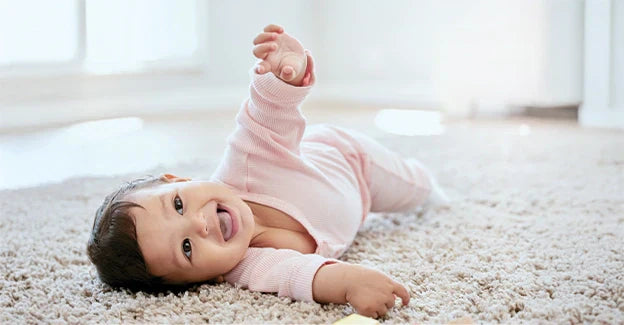
Swaddling can feel like a superpower. Your newborn settles, sleeps longer, and those startle reflex jumps are kept in check. Then one day, the wrap pops open, tiny arms shoot up, and you wonder if it is time to retire the swaddle. If you are asking when to stop swaddling, you are already on the right track.
Swaddling was once your best friend when it came to helping your little bub drift off to sleep. However, as babies grow, swaddling isn’t always the best choice anymore. Let’s talk about the important signs to watch for, how long a baby should be swaddled, and some helpful baby sleep products and tips to make the transition smoother for both you and your little bundle of joy.
When do I stop swaddling?
Here is the simple answer you came for. You stop swaddling when your baby shows signs of rolling. This usually happens around 8 to 12 weeks, sometimes earlier and sometimes a bit later. The exact calendar date matters less than the skill your baby is showing. Rolling changes the safety equation. Once a baby can flip, arms need to be free so they can push up and clear the airway.
While you are still swaddling, choose breathable, well-fitted wraps. The Nintara Baby Wake Me Not Swaddle is designed to feel cosy while allowing a snug, safe fit that does not creep over the face. If you prefer a classic style, Nintara Baby swaddle wraps made from soft, airy fabric help you get that snug tuck without overheating.
My baby breaks out of the swaddle. When do you stop swaddling a baby?
Not always. Breaking out can mean the wrap is too loose, the fabric is too stiff or too stretchy, or the technique needs a small tweak. Before you ditch swaddling, try:
-
Right size and right fabric: Use a wrap that matches your baby’s weight range. Nintara Baby swaddle wraps are sized and cut to reduce slack, so you get a secure wrap without strapping them too tight.
-
Firm but gentle tuck: Keep the chest snug and hips loose. You want room for natural frog-leg movement.
-
Temperature check: If a baby is too warm, wiggling increases. Use light layers. The Wake Me Not Swaddle’s breathable weave helps with airflow.
-
Arms-up vs arms-down: Some babies settle better with hands near the chest or mouth. Test positions to see what brings calm. This is also when should you stop swaddling a baby.
If breakouts come with clear rolling signs, that is different. At that point, you should move to transition strategies so your baby has arms free for safety.
Should I stop swaddling when my baby rolls to their side?
Yes. Side rolling is an early step toward full rolling. This is your green light to start the transition right away. You do not wait for a perfect tummy-to-back flip. The moment you see consistent side-to-side wobbling or attempts to push and pivot, you begin to free the arms.
Here is the quick checklist:
-
Spotted side rolling? Start phasing out the swaddle now.
-
Practising tummy time like a champ? Expect rolling to follow and plan your exit.
-
Night surprises? If your baby wakes on the side while swaddled, switch to a transition method the same night.
How to transition out of the swaddle:
When to stop swaddling a baby? There is no one right time or way. Pick a path that fits your baby’s temperament and your sleep setup. Here are four field-tested options.
1) One-arm-out, then both-arms-out
Swaddle with one arm out. Keep the other arm in. The Nintara Baby Swaddle wraps make this easy because the wrap stays secure even when one arm is free. Free the second arm. Keep the body snug for a few nights. After 4-5 nights, switch to a sleeveless sleep sack or wearable blanket. This method is great for babies who like gradual change.
2) Naps first, nights later
For day naps, use a swaddle with both arms out or a sleep sack. Keep nights as before. In 4-5 days, move nights to both arms out. Retire the swaddle after one week. This route protects night sleep while teaching new skills in the easier nap environment.
3) Cold turkey
Start with moving straight to a sleep sack with arms free. Offer extra soothing at bedtime. White noise, dark room, and a calm routine help a lot. Use this if rolling has already started and you need an immediate change. A good sleep sack and a steady bedtime routine will carry you.
4) Arms-up transition
Some babies love hands near the face. Try a transition swaddle that allows an arms-up position while keeping the torso snug. If you are using Nintara Baby swaddle wraps, leave enough room for hands to find the mouth while ensuring the fabric cannot ride up.
Have a baby older than 5 months and still struggling?
If your baby is past 5 months and swaddling still feels tempting, you are not alone. Many parents wonder when to stop swaddling baby if sleep tanks the moment arms are free. At this age, you should stop swaddling entirely because rolling is common, and babies need arms for safe movement. Focus on sleep-friendly habits:
-
Move fully to a sleep sack: This keeps the cosy signal without restricting arms. Keep the room dark and the routine short and sweet. Nintara Baby even has a good collection of sleep sacks that you may not want to miss.
-
Increase daytime practice: The more your baby practises motor skills while awake, the less flailing shows up in the cot.
-
Use hands for self-soothing: Guide your baby to rub a chest, hold a pacifier, or pat a mattress. This builds new calming tools.
-
Stick with changes for 3 to 5 nights: Sleep often dips before it improves. Give the new setup a proper chance.
-
Check wake windows: Overtired babies thrash more. Age-appropriate awake times help you hit the sweet spot for easier settling.
If you want an easier, safer, and softer swaddle experience while you are still in the window, check out Nintara Baby Wake Me Not Swaddle is designed to stay put without overheating, perfect for one-arm-out transitions. The classic Nintara Baby swaddle wraps are gentle on delicate skin and make it simple to get that snug, hip-healthy fit. Ready to wrap smarter and then move on smoothly? Choose Nintara Baby for baby products that respects your baby’s cues and your peace of mind.


